
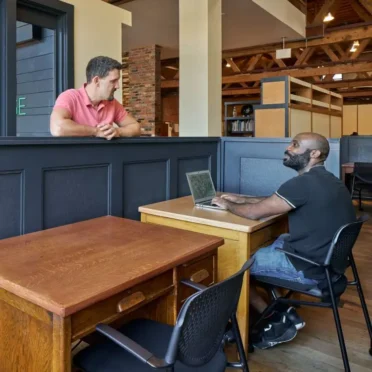
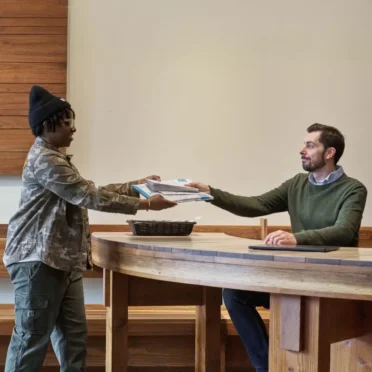


Henry Cesari has been in residence at the Green Garage since he moved to the Cass Corridor in 2024. With a passion for both writing and anything on wheels, Henry is an automotive journalist who covers the auto industry for a variety of websites. He tells us that one of his favorite things about life at the Green Garage are our twice-a-month community lunches, which he makes a point to attend regularly in order to grow his network and learn about the great work going on in Detroit.
Henry CesariAutomotive journalist 
Rhonda Greene is the executive director of Heritage Works, a longstanding nonprofit organization that promotes youth and community development in Detroit through cultural traditions, arts, and education, including African-centric drum and dance education.
Rhonda has operated Heritage Works out of the Green Garage since 2017. She says she values our culture of celebrating each community members’ successes, personal and professional, as well as opportunities to work from our three season room (particularly in the spring) and take part in our regular triple bottom line business leadership conversations.
Rhonda GreeneHeritage Works 
Lindsey Elton is President and Partner at Eco Achievers, a company with offices in Detroit and Chicago. They help residential building developers achieve their sustainability goals through green building certification, code compliance, performance testing, and green financing strategies. Lindsey moved into the Green Garage in 2019 as the sole representative from Eco Achievers in Detroit. Since then, she’s benefited from the opportunity to grow a dedicated team here, a wonderful group that has become an integral part of our community.
Lindsey EltonEco Achievers 
Strawberry Solar is a group of like-minded individuals working towards a better future for the state of Michigan and our planet. With an expertise in solar and battery storage, they help homeowners and businesses achieve energy independence and reduce their carbon footprint. Will Held and the whole Strawberry Solar team joined the Green Garage back in 2018 and, according to Will, they’ve “loved every minute! We started with a two-person office and have steadily grown into a six-person space. Along the way, the Green Garage has been there to offer everything we may need as a small business, and we are so happy to call the Green Garage our headquarters."
Will HeldStrawberry Solar 
Kimberly Williamson is the founder and managing director of Simply Well Communities, a real estate development company committed to strengthening community health through the built environment. She has been a resident of the Green Garage since 2013, when she arrived with a seed of an idea to improve community health by focusing on people-centric, triple bottom line real estate development practices. “I really don’t have adequate words for all the Garage means to me," she says. "The support of this community has been invaluable to the growth of Simply Well—which now is a team of four! The Green Garage was a place where my idea was nurtured and encouraged with warmth and practical, hands-on business learning. At the Green Garage we have grown a sound, sustainable business and lifelong friendships."
Kimberly WilliamsonSimply Well Communities 
Ester Lee works for Key Figures, a financial management firm based in Austin, TX that offers a variety of bookkeeping and financial advisory services, as well as tax preparation and consulting. Ester’s specialty is bookkeeping and financial management for cooperatives, nonprofits and small businesses. Four years ago she chose to relocate to Detroit. Regarding her choice to join us at the Green Garage, Ester says, “The Garage is a hub for a lot of community-focused groups and businesses of Detroit! I’ve met a lot of interesting people doing good work in the city.”
Ester LeeKey Figures 
Rhonda Greene is the executive director of Heritage Works, a longstanding nonprofit organization that promotes youth and community development in Detroit through cultural traditions, arts, and education, including African-centric drum and dance education.
Rhonda has operated Heritage Works out of the Green Garage since 2017. She says she values our culture of celebrating each community members’ successes, personal and professional, as well as opportunities to work from our three season room (particularly in the spring) and take part in our regular triple bottom line business leadership conversations.
Rhonda GreeneHeritage Works
Strawberry Solar is a group of like-minded individuals working towards a better future for the state of Michigan and our planet. With an expertise in solar and battery storage, they help homeowners and businesses achieve energy independence and reduce their carbon footprint. Will Held and the entire Strawberry Solar team joined the Green Garage back in 2018 and, according to Will, they’ve “loved every minute! We started with a two-person office and have steadily grown into a six-person space. Along the way, the Green Garage has been there to offer everything we may need as a small business, and we are so happy to call the Green Garage our headquarters."
Will HeldStrawberry Solar
Kimberly Williamson is the founder and managing director of Simply Well Communities, a real estate development company committed to strengthening community health through the built environment. She has been a resident of the Green Garage since 2013, when she arrived with a seed of an idea to improve community health by focusing on people-centric, triple bottom line real estate development practices. “I really don’t have adequate words for all the Garage means to me," she says. "The support of this community has been invaluable to the growth of Simply Well—which now is a team of four! The Green Garage was a place where my idea was nurtured and encouraged with warmth and practical, hands-on business learning. At the Green Garage we have grown a sound, sustainable business and lifelong friendships."
Kimberly WilliamsonSimply Well Communities
Ester Lee works for Key Figures, a financial management firm based in Austin, TX that offers a variety of bookkeeping and financial advisory services, as well as tax preparation and consulting. Ester’s specialty is bookkeeping and financial management for cooperatives, nonprofits and small businesses. Four years ago she chose to relocate to Detroit. Regarding her choice to join us at the Green Garage, Ester says, “The Garage is a hub for a lot of community-focused groups and businesses of Detroit! I’ve met a lot of interesting people doing good work in the city.”
Ester LeeKey Figures
Henry Cesari has been in residence at the Green Garage since he moved to the Cass Corridor in 2024. With a passion for both writing and anything on wheels, Henry is an automotive journalist who covers the auto industry for a variety of websites. He tells us that one of his favorite things about life at the Green Garage are our twice-a-month community lunches, which he makes a point to attend regularly in order to grow his network and learn about the great work going on in Detroit.
Henry CesariAutomotive journalist
Lindsey Elton is President and Partner at Eco Achievers, a company with offices in Detroit and Chicago. They help residential building developers achieve their sustainability goals through green building certification, code compliance, performance testing, and green financing strategies. Lindsey moved into the Green Garage in 2019 as the sole representative from Eco Achievers in Detroit. Since then, she’s benefited from the opportunity to grow a dedicated team here, a wonderful group that has become an integral part of our community.
Lindsey EltonEco Achievers
